


According to the Vietnam Association of Seafood Exporters and Producers (VASEP), Vietnam’s seafood exports reached about $707 million in February 2026, up 8% year-on-year. Cumulatively, exports in the first two months of 2026 totaled around $1.7 billion, an increase of 20.2%. The results indicate that the industry’s recovery momentum remained intact following strong growth in January, although the pace slowed in February for several key products and markets.
SHRIMP AND PANGASIUS REMAIN PILLARS
Within the product structure, shrimp continued to serve as the industry’s largest pillar. In February 2026, shrimp export value reached about $310 million, up 17% from the same period last year; for the first two months of 2026, exports totaled $689.5 million, nearly 20% higher year-on-year. However, prospects in the U.S. market are facing new pressure after the U.S. Department of Commerce announced the final results of the 19th administrative review (POR19) on frozen shrimp from Vietnam.
Accordingly, the two mandatory respondents—STAPIMEX and the Thong Thuan/TTCR group—were assigned an anti-dumping margin of up to 25.76%, while 22 companies receiving separate rates were subject to a duty of 4.58%. The tariffs increase cost risks and add to cautious sentiment among U.S. importers in the short term. In fact, shrimp exports to the U.S. in February 2026 fell by nearly 60% year-on-year.
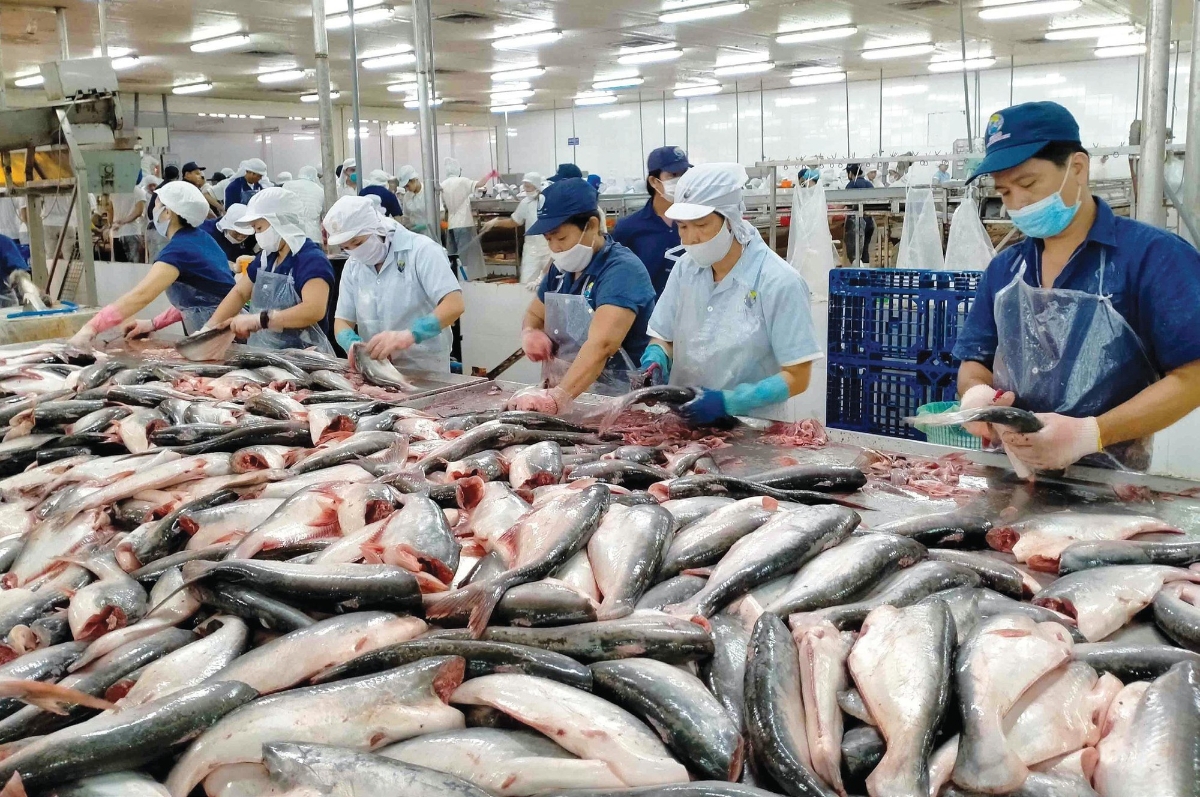
For pangasius, export turnover in February 2026 reached $119.3 million, down 4.8% compared with the same period last year. However, thanks to strong growth in January, cumulative exports for the first two months of 2026 still reached $331.4 million, up 28% year-on-year. This suggests that most of the growth was driven by the strong performance in January, while the market showed signs of adjustment in February.
Pangasius exports to the U.S. declined by about 20%, while several other markets saw slight decreases due to the Lunar New Year holiday. China, however, recorded a positive signal, with pangasius exports rising by about 15% year-on-year.
SEAFOOD EXPORTS SHOW VOLATILITY
In contrast to pangasius, tuna has raised more concerns. In February 2026, tuna exports reached only $53.3 million, down 14.7% year-on-year; cumulative exports for the first two months of 2026 reached $128.7 million, slightly down 0.2% compared with the same period last year. Notably, in February, tuna exports to major markets declined slightly, while shipments to the U.S. dropped by nearly 26% year-on-year.
From January 1, 2026, shipments from fisheries that the U.S. National Oceanic and Atmospheric Administration (NOAA) has refused to recognize as equivalent under the Marine Mammal Protection Act (MMPA) may face import restrictions into the United States. NOAA also stated that Vietnam is among the countries denied equivalency recognition for part of its fisheries, meaning compliance risks for wild-caught seafood entering the U.S. market have increased significantly this year.
Alongside the pressured product groups, several other items have recorded quite positive results. In February 2026, exports of crab and other crustaceans surged by 78.7%, bringing total export value in the first two months of 2026 to $66.2 million, up 24% year-on-year.
Squid and octopus exports were nearly flat in February 2026, slipping slightly by 0.4%, but overall exports for the first two months of 2026 still rose by 23.3% year-on-year. Meanwhile, mollusks with shells recorded the fastest growth rate, with export value increasing 70.3% in February and 38.5% in the first two months. This indicates that early 2026 growth is not relying solely on shrimp but is also spreading across various seafood and mollusk categories.
MARKET DIVERGENCE BECOMES MORE PRONOUNCED
Amid policy fluctuations in the United States in 2026—including tariff changes and technical barriers—along with logistics challenges stemming from conflicts in the Middle East, China is expected to remain a key growth driver for Vietnam’s seafood sector.
The ASEAN market also posted solid growth in the first two months of 2026, reaching $118.6 million, up 21.5%, although February alone saw an 8% decline. The European Union (EU) maintained a more stable growth pace, with exports rising 2.5% in February and 16.9% in the two-month period. Japan recorded a modest increase of 4.8% in the first two months but a sharp decline of 18.3% in February alone, suggesting that demand in this market has yet to fully stabilize.
VASEP forecasts that Vietnam’s seafood exports will likely continue growing in March 2026, although divergence among markets and product groups is expected to become more pronounced. One supportive factor is the Seafood Expo North America 2026 in Boston, scheduled for March 15–17, which may provide opportunities for businesses to meet customers, reconnect orders, and explore demand for the second quarter of 2026.
However, the business environment in the United States is expected to become more unpredictable due to the impact of new tariff policies, the POR19 results on shrimp, and stricter compliance requirements under the MMPA. In the short term, shrimp exporters and wild-caught seafood businesses are advised to remain particularly cautious with the U.S. market, while growth opportunities may continue to lean more toward China, the EU, and partly ASEAN.
Source: VnEconomy.vn

