


January coincides with the period leading up to the Lunar New Year, when demand for fruit in the Chinese market as well as within overseas Vietnamese communities rises sharply, contributing to export growth. Beyond seasonal factors, the quality of Vietnamese fruits and vegetables has continued to improve, meeting the stringent phytosanitary standards of high-requirement markets such as the United States and the European Union.
CHINA REMAINS THE LARGEST MARKET
In terms of market structure, China continues to be the largest importer of Vietnamese fruits and vegetables. In January 2026, export turnover to this market reached nearly USD 376 million, up 117.6% year-on-year and accounting for 58.31% of the sector’s total export value. Key products included durian, banana, dragon fruit, mango and coconut. The robust growth indicates that domestic enterprises have effectively tapped into traditional markets while accelerating official export channels and enhancing traceability compliance.
The United States ranked second, with export turnover of approximately USD 48.54 million, up 56.1% compared to January 2025. Exports to the U.S. mainly consisted of processed fruit and vegetable products and specialty fruits such as pomelo and coconut. The results reflect a rising share of high value-added products in the export structure.
In the EU market, processed fruit and vegetable products and fruit juices continued to dominate. Although growth was not as dramatic as in China, exports to the EU maintained steady momentum, demonstrating the adaptability of Vietnamese enterprises and their improving quality standards.
The year 2025 marked a significant milestone for Vietnam’s fruit and vegetable sector, with export turnover reaching USD 8.56 billion, up nearly 20% compared to 2024. Notably, exports of processed fruit and vegetable products surpassed USD 2 billion for the first time. According to Dang Phuc Nguyen, General Secretary of the Vietnam Fruit and Vegetable Association (Vinafruit), the result reflects not only strong growth but also a positive shift in market structure and export product composition.
China remained the largest market in 2025, with export turnover exceeding USD 5.5 billion. Vietnam rose to second place, behind Thailand, among fruit and vegetable exporters to China. At the same time, Vietnamese produce made breakthroughs in demanding markets, with exports to the United States, South Korea and Japan posting encouraging growth, underscoring improvements in quality and standards.
The EU recorded impressive growth of around 58% compared to 2024, thanks to effective utilization of tariff preferences. Potential markets such as Australia also maintained positive momentum, promising higher added value in the near future. The diversification strategy has gradually reduced dependence on a handful of markets.
STRONG RESTRUCTURING TOWARD A USD 10 BILLION TARGET
In terms of product structure, 2025 saw a clear shift toward higher value. Durian remained the top export with turnover of USD 3.86 billion, accounting for 45% of total sector exports. Growth was driven by expanded certified growing areas and deeper penetration into high-value markets such as the United States and the EU.
Coconut, both fresh and processed, gained strong traction following the signing of a protocol allowing fresh coconut exports to China. Meanwhile, dragon fruit maintained its position despite fierce competition by pivoting to India and Middle Eastern markets. Other fruits such as mango, pomelo, passion fruit and longan continued to grow steadily; notably, passion fruit accounted for around 25% of exports to the EU, signaling significant room for expansion.
According to Dr. Dinh Cao Khue, Vice Chairman of the Vietnam Fruit and Vegetable Association and Chairman and CEO of Dong Giao Foodstuff Export JSC (Doveco), Vietnam’s fruit and vegetable sector has moved beyond reliance on traditional markets and familiar products. It is now consolidating established markets, breaking into demanding ones and gradually capturing higher value-added segments.
Alongside market shifts, product restructuring has gained momentum. Industry linkages are reducing dependence on a limited number of traditional products and moving toward diversification of products, markets and processing methods. This transformation lays the foundation for a more sustainable development cycle.
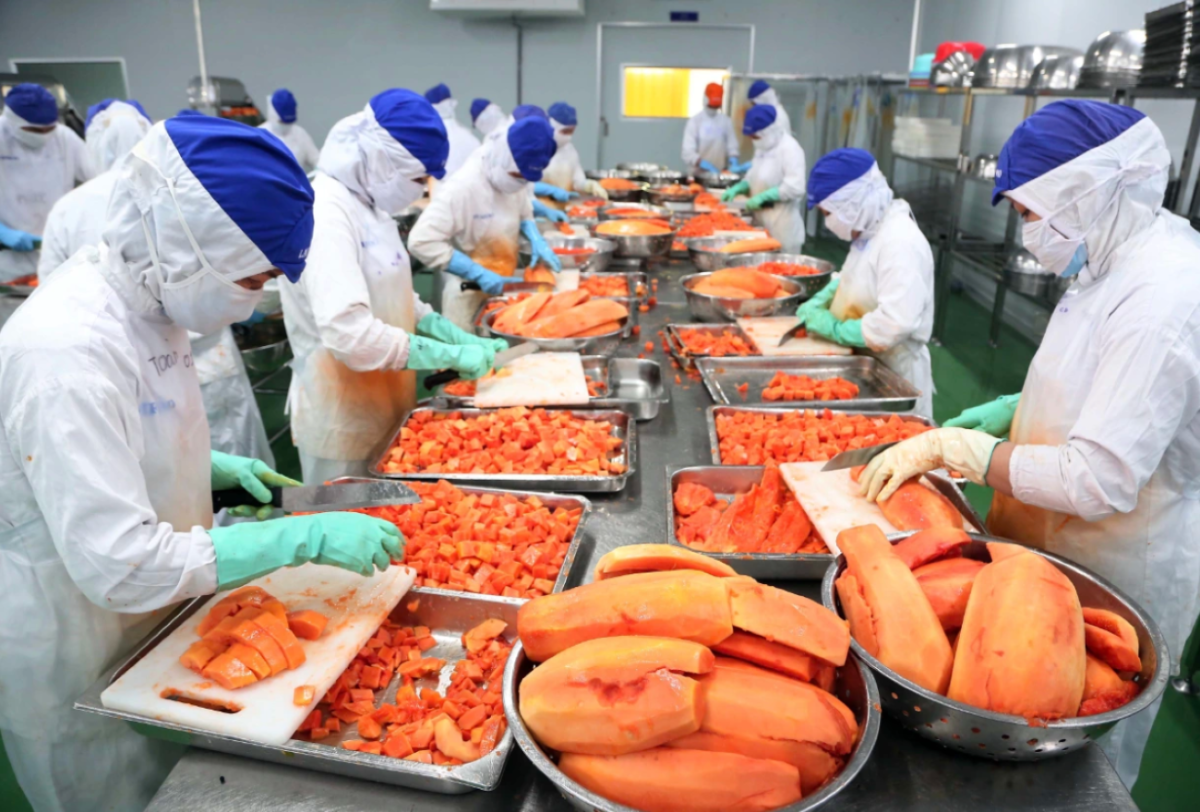
Doveco’s operations reflect this trend. The company manages more than 30,000 hectares of raw material areas and operates three modern processing centers in Ninh Binh, Son La and Gia Lai, with a total capacity of 136,000 tons per year, exporting to more than 50 countries. Along with expanding cultivation areas, Doveco has invested heavily in technology, automating up to 90% of its production lines with integrated equipment imported from Japan, Germany, the United States and other G7 countries. Notably, Swedish Tetra Pak and Tetra Recart lines have been introduced for the first time in Vietnam, enabling sterilization in just 30 seconds instead of the previous 30–45 minutes, preserving natural flavors without preservatives. This represents not only a leap in quality but also a commitment to green production, reduced plastic emissions and sustainable development.
Based on analyses of domestic demand and key markets such as Europe, the United States, Japan and South Korea, industry leaders believe there remains substantial room for growth in processed and high-quality fruit and vegetable products, provided that standards and consumer preferences are fully met.
Dr. Khue has proposed three pillars for development: expanding and reorganizing raw material areas sustainably while strengthening value-chain linkages; investing deeply in processing to enhance value; and proactively expanding into premium market segments. With synchronized implementation of these solutions, raising fruit and vegetable export turnover to USD 10–20 billion in the coming years is considered achievable.
Source: vneconomy.vn

