


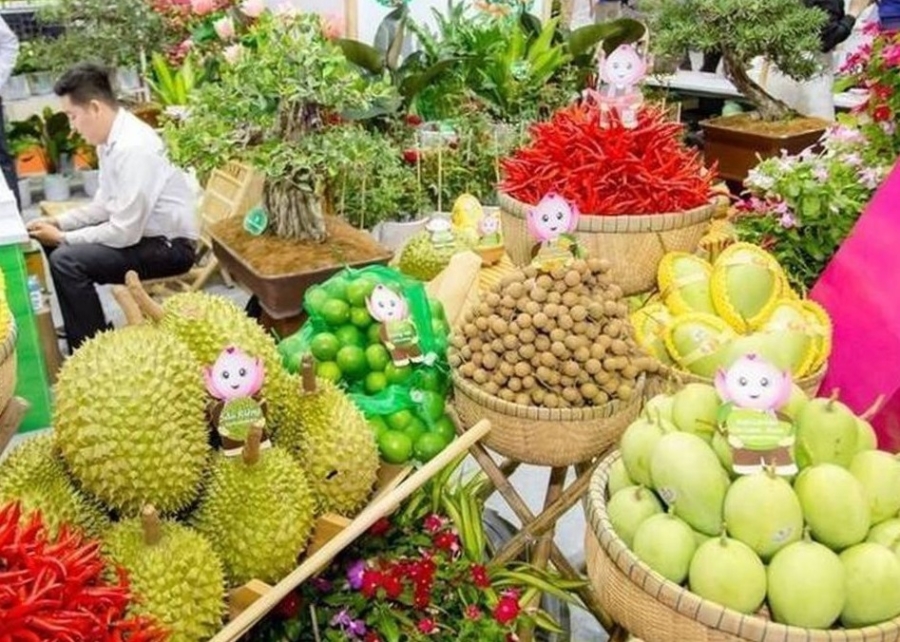
At the Conference reviewing performance in 2025 and outlining tasks for 2026 of the Agriculture and Environment sector, Nguyen Thanh Binh, Chairman of the Vietnam Fruit and Vegetable Association, delivered a presentation highlighting key bright spots of the fruit and vegetable industry, while analyzing the conditions needed to achieve the 10 billion USD export target.
In 2025, fruit and vegetable export turnover set a new record. Mr. Nguyen Thanh Binh said that from the beginning of 2025 to December 31, 2025, Vietnam’s total fruit and vegetable export value was estimated at between 8.5 and 8.6 billion USD, an increase of about 1.3–1.4 billion USD compared to 2024, equivalent to growth of nearly 18%. This result far exceeded initial forecasts, clearly reflecting the strong and sustained growth momentum of Vietnam’s fruit and vegetable sector over the past year.
Throughout 2025, the Vietnam Fruit and Vegetable Association implemented a range of practical activities to connect and strengthen linkages among member enterprises, while closely coordinating with local authorities to enhance cooperation between export companies, producers, farmers, and cooperatives. This approach has contributed to the formation and consolidation of fruit and vegetable production–consumption chains across many raw material areas.

At the same time, trade promotion activities continued to be intensified. The Association organized business delegations to participate in numerous international trade fairs and exhibitions, thereby expanding access to new markets and customers. The effectiveness of these programs has been recognized by the business community, as reflected in the growing number of enterprises registering to take part.
Beyond market promotion, the Association has placed strong emphasis on guiding and encouraging producers and enterprises to comply with domestic regulations as well as the standards of importing markets. As a result, Vietnamese fruit and vegetables are increasingly favored in many markets, while violations in export activities have been reduced.
The achievements of the fruit and vegetable sector in 2025 are the result of coordinated efforts across the entire system, from Party committees and authorities at all levels, central and local ministries and agencies, to enterprises and producers.
In this process, the Ministry of Agriculture and Environment has played a key role by directing the restructuring of production, shifting from small-scale, fragmented models to more concentrated and modern production. This transition has helped create a range of new, high-quality products that better match consumer preferences. At the same time, negotiations to open markets for key fruit and vegetable products have continued to be promoted, creating additional room for export growth.
Contributing to the overall picture are also the creativity and proactiveness of producers, along with the commitment and entrepreneurial spirit of businesses and entrepreneurs, particularly in newly developed production areas that still face many difficulties.
Challenges that need to be addressed
Alongside positive results, the fruit and vegetable sector continues to face a number of challenges. Product quality remains inconsistent, with low levels of uniformity, and cases of banned substance residues still occur in some products. The traceability system has yet to be fully completed, while the issuance and management of planting area codes, packing facility codes, as well as inspection, testing, and certification activities still show shortcomings, affecting the speed and efficiency of exports.
In particular, in the Chinese market, linkages between domestic production and consumption are not yet truly sustainable, posing risks of disruption when market conditions fluctuate.
However, building on many consecutive years of double-digit growth, and in the context of Vietnam being among the world’s top 25 countries in terms of import-export turnover, the Vietnam Fruit and Vegetable Association believes that fruit and vegetable exports in 2026 could reach the 10 billion USD milestone.
To realize this goal, the Association recommends focusing on improving product quality and safety, completing a traceability system capable of international connectivity, and rectifying inspection, testing, and certification activities to ensure fast customs clearance and maintain the reputation of Vietnamese goods.
At the same time, efforts should be stepped up to promote the image of Vietnamese fruit and vegetables and enhance trade promotion in terms of frequency, scale, and formats. The Association also proposes the establishment of a sectoral research and development fund, aimed at applying new technologies in post-harvest handling, preservation, and extending product shelf life.
At the conference, Minister of Agriculture and Environment Tran Duc Thang stated that from January 1, 2026, Vietnam’s agricultural product traceability system will officially come into operation. This digital platform is designed to record, manage, and provide access to origin information for agricultural, forestry, and fishery products throughout the processes of production, processing, transportation, and market circulation.
Through this system, consumers will be able to verify product information transparently, while regulatory authorities will have a basis for monitoring, statistics, and trace-back when necessary. The Minister expressed his expectation that the traceability system will become an important tool supporting the fruit and vegetable sector in achieving its targets in 2026.
With the current growth momentum and the coordinated engagement of all stakeholders, the 10 billion USD export target for fruit and vegetables is no longer merely an aspiration, but is gradually becoming an achievable destination for the sector in the coming year.
Source: vneconomy.vn

