


In the opposite direction, total fruit and vegetable imports in 2025 are estimated at around USD 3 billion. As a result, Vietnam’s fruit and vegetable sector recorded a trade surplus of more than USD 5.5 billion — a very high level of surplus that continues to underscore the sector’s role as a key pillar in the country’s agricultural export structure.
CHINA REMAINS THE CORE MARKET
In the overall picture of fruit and vegetable exports in 2025, China continued to be the largest market. In the first 11 months of the year, exports to China reached nearly USD 5 billion, up 15 percent year on year and accounting for as much as 64 percent of the sector’s total export turnover.
Notably, despite the impact of tariff policies, fruit and vegetable exports to the US market still posted very strong growth, rising by as much as 56 percent in the first 11 months to approximately USD 500 million. Meanwhile, several other markets maintained export turnover of over USD 100 million, including South Korea, Japan, Taiwan and the Netherlands, highlighting the increasingly clear potential for Vietnam’s fruit and vegetable exports to expand into diversified markets.
According to Dang Phuc Nguyen, Secretary General of the Vietnam Fruit and Vegetable Association (Vinafruit), fruit and vegetable exports faced many difficulties at the beginning of 2025, particularly in the Chinese market due to technical barriers related to durian, the country’s key export product. US tariff policies also created certain impacts. However, thanks to the flexible and timely involvement of the Government, the Ministry of Agriculture and Environment, along with enterprises’ efforts to adapt, export turnover accelerated sharply in the second half of the year, setting a new record.
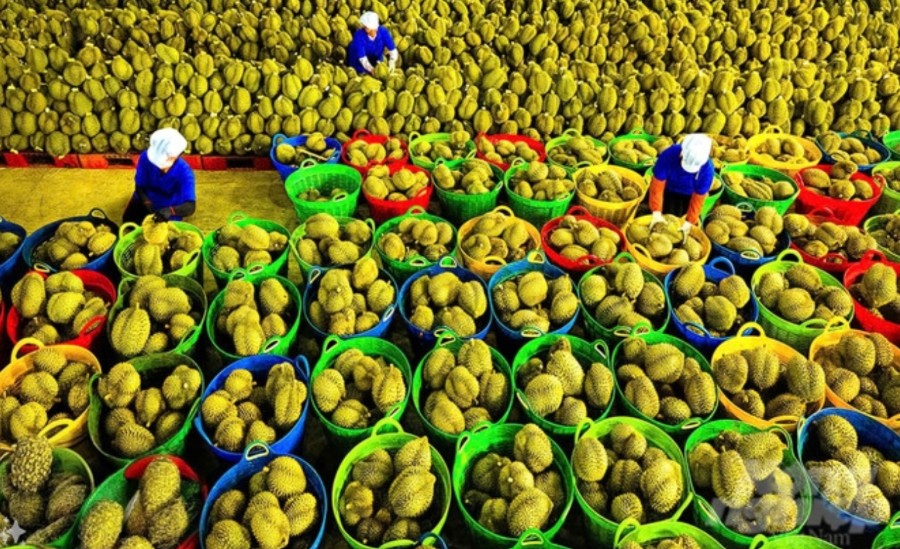
Vinafruit reported that in the first 10 months of the year, durian exports reached USD 3.34 billion, up 10.3 percent year on year and accounting for 47.28 percent of the country’s total fruit and vegetable export value. This figure reflects a very high level of concentration on a single flagship product, while also underscoring the importance of durian in the current export structure.
Among other fruit categories, performance showed clear differentiation. Dragon fruit reached USD 434.17 million in the first 10 months, almost unchanged year on year, accounting for 6.15 percent of total export turnover. Banana exports performed more positively at USD 335.95 million, up 10.1 percent, while mango exports reached USD 240.79 million, an increase of 14 percent.
By contrast, several fruits showed a marked slowdown. Jackfruit recorded only USD 148.41 million in export value in the first 10 months, down 25.1 percent year on year. Longan exports reached USD 48.04 million, down 13.1 percent, more clearly reflecting rising competitive pressure and increasingly stringent technical requirements for traditional fruit products.
RAPID GROWTH IN “NICHE” EXPORT PRODUCTS
Alongside key products, 2025 also witnessed very strong growth in several product lines with relatively small scale but high growth rates. Pistachios reached USD 76.42 million, up 163.6 percent. Lychee exports totaled USD 73.28 million, surging 310.7 percent year on year. Although each product accounted for only about 1 percent of total export turnover, the rapid growth highlights considerable room for expansion if quality standards and market stability can be maintained.
Fresh vegetable products, while smaller in scale, also maintained growth momentum. In the first 10 months, export turnover reached USD 351.88 million, up 14.3 percent year on year and accounting for nearly 5 percent of total fruit and vegetable exports. Chili peppers were the largest item in this group at USD 95.24 million, up 21.2 percent. Ginger reached USD 26.88 million, up 34.7 percent. Notably, garlic exports totaled USD 19.39 million, but surged by as much as 101 percent year on year, despite its still modest share.
Within the processed product segment, processed pineapple led with USD 292.06 million, up 55.8 percent. Processed passion fruit reached USD 150.60 million, up 35.3 percent. Processed pistachios recorded USD 147.29 million, up 32.3 percent. Processed almonds posted a sharp increase of 87.1 percent to USD 129.88 million, while processed mango reached USD 109.77 million.
The strong growth of processed products indicates that the “value-added” component of Vietnam’s fruit and vegetable value chain is expanding, helping to gradually reduce dependence on fresh exports and enhance resilience against market fluctuations.
The Ministry of Agriculture and Environment, Vinafruit and many enterprises all view 2025 as a breakthrough year for the fruit and vegetable sector. However, this outcome was not the result of inertia-driven growth. From early in the year, the sector had to confront a series of stringent requirements related to planting area codes, traceability, residue control and food safety.
Many enterprises were forced to adjust their processes for preliminary processing, packaging, preservation and storage to meet new standards. This process of “standardization” helped many shipments overcome technical barriers, laying the foundation for the strong growth seen in the second half of the year.
According to Dang Phuc Nguyen, the rapid and timely involvement of the Government and the Ministry of Agriculture and Environment, especially during peak fruit export periods, has been a key factor enabling the fruit and vegetable sector to maintain growth and set records for the third consecutive year. From USD 3.34 billion in 2022 to USD 5.6 billion in 2023 and USD 7.2 billion in 2024, the sector has made significant strides, surpassing the USD 8.5 billion mark for the first time in 2025 and laying the groundwork for even higher targets in the coming years.
Source: vneconomy.vn

