


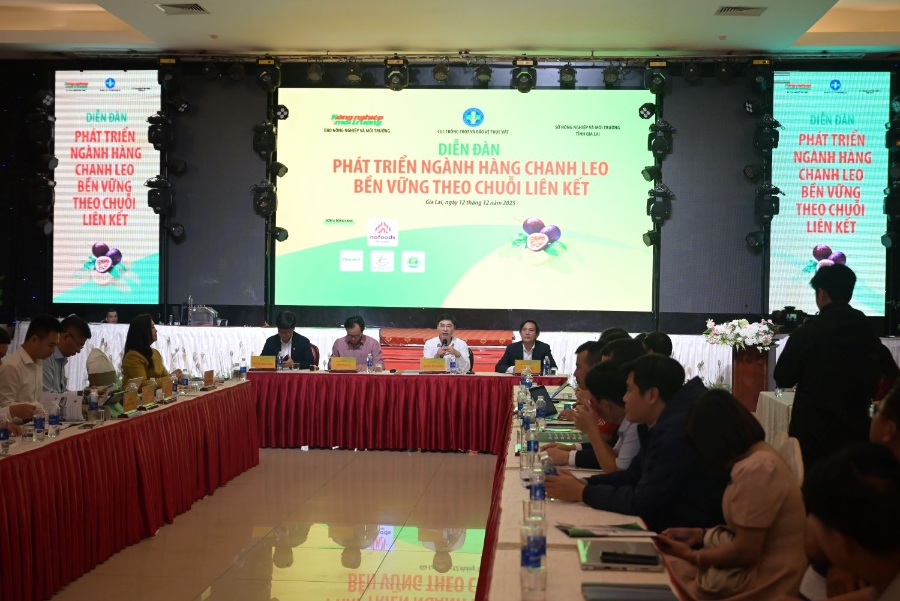
On December 12, 2025, in Pleiku Ward, Gia Lai Province, the Agriculture and Environment Newspaper, in coordination with the Department of Crop Production and Plant Protection and the Gia Lai Department of Agriculture and Environment, organized the forum “Developing the Passion Fruit Sector Sustainably through Value Chain Linkages,” with the participation of numerous regulatory agencies, experts, and leading enterprises in the industry.
THE CENTRAL HIGHLANDS EMERGE AS VIETNAM’S “CAPITAL” OF PASSION FRUIT
Mr. To Van Huan, representative of the Department of Crop Production and Plant Protection, said that the Central Highlands is currently the largest passion fruit production hub in the country, accounting for 86.4% of the cultivated area and 92.5% of output in 2024. Northern provinces account for around 12.5% of the total area. Vietnam has officially approved 43 passion fruit varieties to meet the growing demand for production and export.
Vietnam boasts ideal natural conditions for passion fruit cultivation, particularly in the Central Highlands, where the crop has a short growing cycle of just four to five months and achieves high yields. More than 80% of current output is used for processing and fresh consumption, significantly expanding export markets.
However, the sector still faces numerous challenges, including inconsistent management of disease-free planting material, fragmented small-scale production, non-uniform cultivation techniques, weak value chain linkages, and preservation and deep-processing technologies that have yet to keep pace with demand. Meanwhile, technical barriers and quarantine requirements in importing markets are becoming increasingly stringent.
From this reality, Mr. Huan proposed that local authorities review cultivated areas, develop concentrated production zones linked with infrastructure and processing facilities, curb spontaneous expansion, and encourage cooperatives to partner with enterprises through contract farming and traceability systems. At the same time, the sector should prioritize disease-free varieties, standardized cultivation techniques, pest forecasting, and staggered harvesting to stabilize supply. Expanding markets, removing quarantine barriers, and strengthening the Vietnamese passion fruit brand were also identified as key factors.
Mr. Doan Ngoc Co, Deputy Director of the Gia Lai Department of Agriculture and Environment, said that the official export of passion fruit to China since July 2022 has provided a major boost, significantly increasing value across the entire chain. Many enterprises have partnered with cooperatives and farmers to establish closed production–processing–consumption chains, meeting requirements for planting area codes, packaging standards, and deep processing.
However, Gia Lai in particular and the passion fruit sector in general continue to face challenges from climate change, fragmented cultivation areas, and uneven seed quality. Major markets such as the EU, the United States, Japan, and China impose very high requirements on food safety, plant quarantine, and production standards. Meanwhile, many export orders cannot yet be fulfilled, not due to a lack of output but because of insufficient products meeting GlobalGAP or other technical standards required by importing markets.
THE QUALITY AND MARKET CHALLENGE
According to Mr. Dao Van Cuong, an official at the Vietnam SPS Office, the State has issued several national standards for passion fruit, including TCVN 11411:2016 for fresh fruit, TCVN 13941:2023 for frozen products, and TCVN 13942:2023 for soft-dried products. Nevertheless, importing markets apply strict SPS measures.
In China, fresh passion fruit exports are governed by a protocol between Vietnam’s Ministry of Agriculture and Environment and the General Administration of Customs of China, requiring products to be free from quarantine pests of concern.
Australia has allowed imports of fresh passion fruit from Vietnam following a biosecurity risk analysis, with mandatory irradiation to eliminate insects such as fruit flies, mealybugs, scale insects, and mites.
In the United States, passion fruit must comply with FDA regulations on pesticide residues, and production facilities are required to apply HACCP. The EU has continuously tightened standards, placing certain products, including passion fruit from Thailand and durian from Vietnam, under enhanced control. Japan and the United Kingdom have also adjusted maximum residue limits for many active substances.
Against this backdrop, Ms. Nguyen Thi Bich Ngoc, Deputy Director of the Plant Protection Research Institute, recommended the early development of a set of standards for disease-free passion fruit varieties, stricter management of commercial seedlings, and the application of a three-tier net-house model for seed production. She also called for the formation of large-scale raw material zones with uniform varieties and technical processes, under regular pest monitoring and early warning by the Institute.
Developing VietGAP- and GlobalGAP-certified models is seen as a key solution to improving quality and meeting export requirements. Mr. Ho Hai Quan, Director of Nafoods Tay Nguyen Joint Stock Company, noted that global consumption trends favor natural products with minimal chemical treatment, high nutritional value, and health benefits. This presents a major opportunity for Vietnamese passion fruit to expand market share, particularly in beverages and processed products.
According to Mr. Quan, sustainable value chain linkages among farmers, cooperatives, processing enterprises, suppliers, and distributors are decisive. Such linkages must be based on clear offtake contracts, shared benefits and risks, and strict compliance with technical standards and traceability requirements.
Mr. Nguyen Manh Hung, CEO of Nafoods Group, said that for the Central Highlands, especially Gia Lai, to maintain its position as the country’s leading “passion fruit capital,” growers must proactively master techniques and adapt to the crop’s sensitivity to weather, pests, and high production standards.
Expressing particular concern over pesticide residues—the biggest risk facing the sector—Mr. Hung said that concentrated passion fruit products, a key export item, are encountering barriers because chemical residue levels can be many times higher than those in fresh fruit. A single violating shipment could damage the reputation of the entire industry. As a result, Nafoods has supported farmers from seed selection to cultivation techniques, aiming to build raw material zones that comply with safety standards, enabling enterprises to process with confidence and compete in demanding markets.
Source: vneconomy.vn

