


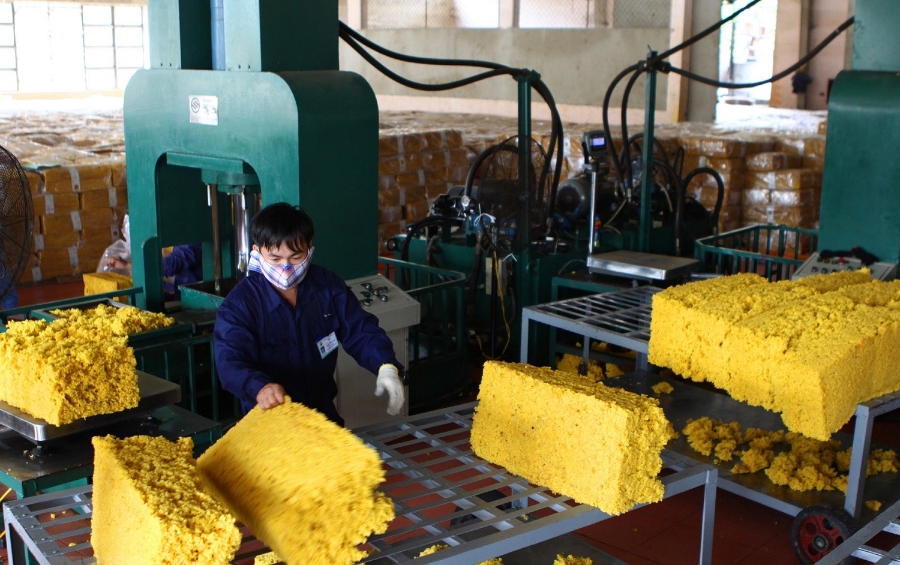
According to data from the Ministry of Agriculture and Environment, Vietnam’s rubber exports in November 2025 were estimated at 180,000 tonnes, worth 306.2 million USD. In the first 11 months of 2025, rubber exports reached 1.7 million tonnes with a value of 2.89 billion USD, down 6.8% in volume and 2.4% in value year-on-year.
CHINA REMAINS THE LARGEST MARKET
In the first 11 months of 2025, China remained Vietnam’s biggest rubber importer, accounting for 71.8% of the total market share. India and Indonesia followed with respective shares of 4.8% and 2.6%.
In terms of export value growth among the 15 largest markets, Indonesia posted the strongest increase, up 92.6%, followed by China with 8.9%. In contrast, India recorded the sharpest fall, down 36.6%.
According to the Vietnam Rubber Association, Vietnam’s traditional export “strongholds” are weakening significantly. India — the country’s second-largest market — saw a severe decline. Similarly, exports to the U.S. plunged by 56.2%.
More concerning were signals from China. Although exports to this market still increased slightly over the 11-month period, data from October and November showed a clear slowdown, with shipments dropping by up to 19%. Analysts said demand in the 1.4-billion-population economy is under pressure as the country’s electric vehicle industry faces an intense price war, forcing manufacturers to tighten input costs.
Amid the overall gloom, Southeast Asia emerged as a bright spot. Indonesia doubled its imports from Vietnam to nearly 38,500 tonnes in the first 11 months of 2025, rising to become Vietnam’s third-largest rubber export market. Malaysia — long known as a global rubber powerhouse — has become a new growth driver for Vietnamese rubber. In the first 10 months of 2025, Vietnam exported 40,659 tonnes to Malaysia, up 63.7% year-on-year, making it the fourth-largest market.
Global rubber prices in early December 2025 were torn between two opposing factors. Extreme weather and flooding in Thailand in late November raised concerns about supply disruptions from the world’s largest exporter. However, downward pressure remained strong as the global supply–demand balance continues to tilt toward oversupply. According to estimates by the Association of Natural Rubber Producing Countries (ANRPC), global supply in the first nine months of 2025 increased 2.3%, while consumption fell 1.5%.
In the short term, Vietnam’s rubber exports are unlikely to rebound strongly as China — the sector’s “locomotive” — slows down. In this context, the successful recovery in Malaysia and Indonesia not only temporarily cushions sales but also represents a strategic direction to reduce dependence on any single market.
VRG STILL EXCEEDS ITS 2025 TARGET
Despite global economic fluctuations and declining natural rubber exports, the Vietnam Rubber Group (VRG) maintained stable and strong growth in 2025.
According to VRG, despite significant challenges — including volatile input prices and extreme weather damaging plantations — the Group achieved outstanding financial results: consolidated revenue surpassed 32 trillion VND, exceeding the plan by more than 3%, and pre-tax profit reached nearly 7 trillion VND, up more than 23% from 2024. This marks one of VRG’s most impressive growth years in recent times. The Group also achieved the Government’s 8% growth target, contributing to budget balance and preservation of state capital.
Sales were a highlight for VRG in 2025, with over 535,000 tonnes of products supplied to the market, meeting demand from major buyers. Notably, the launch of the “VRG Green” label marked an important milestone in developing transparent, environmentally friendly, internationally aligned products.
Alongside its core business, VRG’s industrial parks and renewable energy sectors continued to serve as new growth engines. In 2025, industrial park revenues reached 2.77 trillion VND with profits of over 1.25 trillion VND; newly leased land expanded by 128 hectares, up 67% year-on-year. Average occupancy across the system exceeded 86%, underscoring the attractiveness of VRG’s rubber-based industrial park model.
In renewable energy, VRG’s solar and hydropower projects operated stably, generating over 526 million kWh of commercial electricity and reducing more than 10,600 tonnes of CO₂ emissions, marking an important step in its green transition strategy.
Overseas investments continued to yield strong results, with more than 113,000 hectares of rubber in the business phase, contributing nearly 40% of VRG’s total output. Revenue reached over 1.76 trillion VND in Laos and more than 6.65 trillion VND in Cambodia, both surpassing targets.
Beyond economic contributions, VRG created jobs for more than 25,000 workers in the two neighboring countries and implemented numerous social welfare programs, contributing to border stability and strengthening Vietnam’s international cooperation role.
Entering 2026, VRG aims for consolidated revenue of over 33.4 trillion VND and pre-tax profit of about 7.275 trillion VND. The Group plans to streamline its organizational structure, accelerate digital transformation, and apply technology across the value chain — from agriculture to industry and services.
Additionally, VRG will focus on developing next-generation industrial parks, expanding renewable energy, managing land and forest resources sustainably, and enhancing human resource quality.
With the solid foundation built in 2025, VRG expects to maintain its leading position in the rubber industry and contribute positively to national socio-economic development in the new period.
Source: vneconomy.vn

