


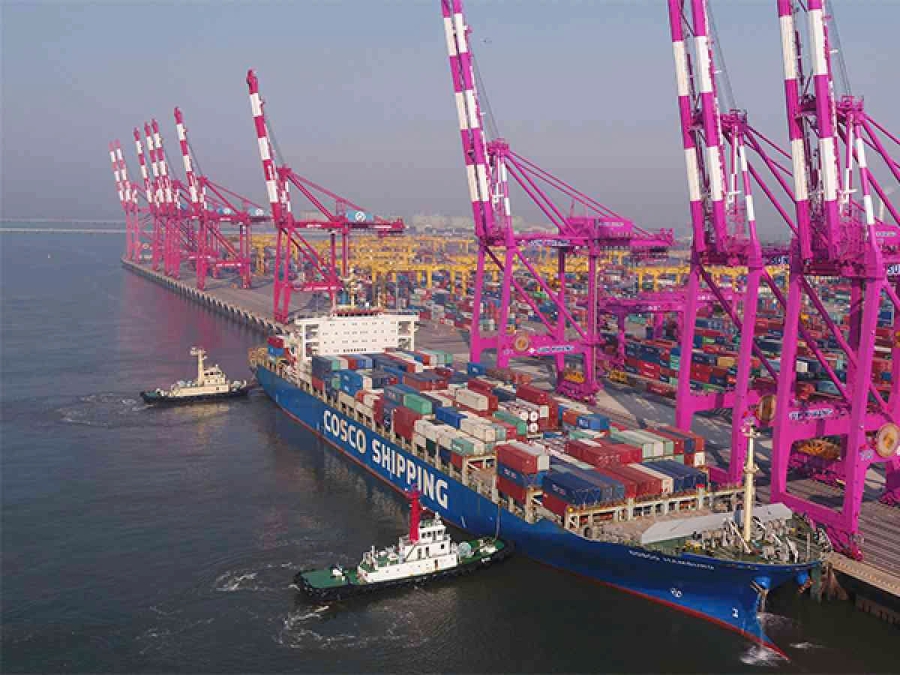
The above figures clearly demonstrate the increasingly deep economic integration between the two economies. Against the backdrop of a strong restructuring of global supply chains, Vietnam–South Korea economic cooperation is shifting markedly from expanding scale to improving quality, particularly in high-tech industries, energy, and logistics.
Bilateral trade: Large scale, complementary structure
Sharing an overview of bilateral trade and investment between Vietnam and South Korea, Nguyen Manh Dong, from the Department of Overseas Markets under the Ministry of Industry and Trade, said South Korea is currently the largest foreign investor in Vietnam, with total accumulated registered investment capital reaching USD 92 billion through more than 10,000 projects as of 2024.
In terms of trade, South Korea is Vietnam’s third-largest trading partner, after China and the United States. At the same time, South Korea is Vietnam’s third-largest export market, after China and the United States, and Vietnam’s second-largest import market, after China.
In 2024, total two-way trade between Vietnam and South Korea reached USD 81.5 billion. Of this, Vietnam’s exports to South Korea amounted to USD 25.6 billion, while imports from South Korea reached USD 55.9 billion, resulting in a trade deficit of USD 30.3 billion for Vietnam.
In addition, toward the goal of achieving more balanced bilateral trade of USD 150 billion by 2030, Vietnam’s Ministry of Industry and Trade and South Korea’s Ministry of Trade, Industry and Energy signed an Action Plan in April 2025. The plan aims to address trade barriers while promoting cooperation in industry and energy between the two countries.
In terms of product structure, Vietnam’s key exports to South Korea include textiles and garments, electronics, agricultural products, wood products, chemicals, and high-tech industrial products.
Among these, the textile and garment sector is one of Vietnam’s leading export industries to South Korea, with export turnover reaching USD 4.2 billion in 2024, accounting for 23 percent of Vietnam’s total exports to this market. Thanks to advantages from the Vietnam–Korea Free Trade Agreement, import tariffs on textiles and garments have been reduced from 12 percent to zero, enhancing the competitiveness of Vietnamese products compared with those from China and Bangladesh.
Meanwhile, Vietnam’s exports of agricultural products and processed food to South Korea reached USD 2.1 billion in 2024. Of this, coffee exports accounted for USD 450 million, cashew nut exports USD 350 million, and seafood exports USD 620 million.
Other potential export items include wood and furniture, valued at USD 150 million in 2024, chemical exports of USD 1.2 billion, and software exports to South Korea of USD 0.6 billion.
South Korean FDI: Shifting toward high technology
A notable feature of Vietnam–South Korea economic relations in recent years is the clear qualitative shift in foreign direct investment flows. Major conglomerates such as Samsung, LG, SK, Hanwha, and LS are expanding investment in electronics, semiconductors, batteries, energy, data centers, new materials, and research and development.
Speaking at the seminar “Promoting Vietnam’s Trade Cooperation with Japan and South Korea in the New Period,” organized by the Ministry of Industry and Trade in Ho Chi Minh City, Nguyen Duy Kien from the Department of Overseas Markets said South Korean investment flows into Vietnam are showing a clear shift toward higher quality.
According to Kien, this shift is closely linked to South Korean enterprises’ global supply chain restructuring strategies. Amid rising trade tensions and geopolitical risks, South Korean companies are diversifying production locations under the “China + 1” model. Vietnam is being selected not only for cost advantages, but more importantly for its stable investment environment and its potential to participate more deeply in technology value chains.
Currently, more than 70 percent of Vietnam’s exports to South Korea consist of high-tech products, electronic components, and supporting products for the semiconductor industry—a significant change compared with 10 to 15 years ago.
Kien noted that major conglomerates such as Samsung, SK, LG, Hanwha, and LS are not only investing on a large scale but are also focusing on high-tech fields, including electronics, semiconductors, artificial intelligence, research and development, energy, batteries, data centers, new materials, automation, and energy-saving solutions.
If one looks back about 15 years, Vietnam’s export structure to South Korea was still dominated by traditional products such as textiles, footwear, and agricultural goods. Today, Vietnam is no longer merely a trading partner but has gradually become an important link in South Korea’s technology value chain. In practice, more than 70 percent of Vietnam’s current exports to South Korea are high-tech products, electronic components, and supporting products for the semiconductor industry.
This is evident in the fact that Samsung has moved beyond phone assembly to expand production into camera modules, circuit boards, and supporting semiconductor components. LG not only manufactures televisions but has also developed a supply chain for display modules and electronic components for the automotive industry. SK is not only active in semiconductors but has expanded into energy, batteries, battery materials, and data centers.
Notably, Hanwha has invested in building an aircraft engine manufacturing plant, enabling Vietnam to participate in the aviation production chain, a sector with very high entry barriers. These are investments typically made only in countries that South Korean enterprises regard as long-term industrial partners.
From this reality, Kien assessed that Vietnam is facing several important opportunities.
First, opportunities to attract high-quality FDI associated with technology transfer and enhanced production capacity.
Second, opportunities to develop supporting industries and gradually integrate more deeply into global value chains.
Third, opportunities to promote infrastructure and logistics development, while creating jobs and expanding international economic integration. Large investment projects also generate spillover effects in areas such as housing, distribution, and tourism.
However, representatives of the Ministry of Industry and Trade also cautioned that alongside opportunities, challenges must be frankly acknowledged. Vietnam remains relatively dependent on the FDI sector, while localization rates are still low. Infrastructure and workforce quality have yet to fully meet the requirements of high-tech industries.
In addition, competitive pressures, both domestic and international—particularly regarding rules of origin and certificates of origin—are increasing, requiring enterprises and management agencies to prepare more thoroughly.
Vietnam–South Korea economic relations are entering a new phase, where the scale of cooperation is sufficiently large and quality requirements are becoming increasingly clear. As global supply chains continue to restructure, the ability to seize opportunities will depend on the extent of enterprise upgrading and the effectiveness of policy coordination between the two sides.
Source: vneconomy.vn

