


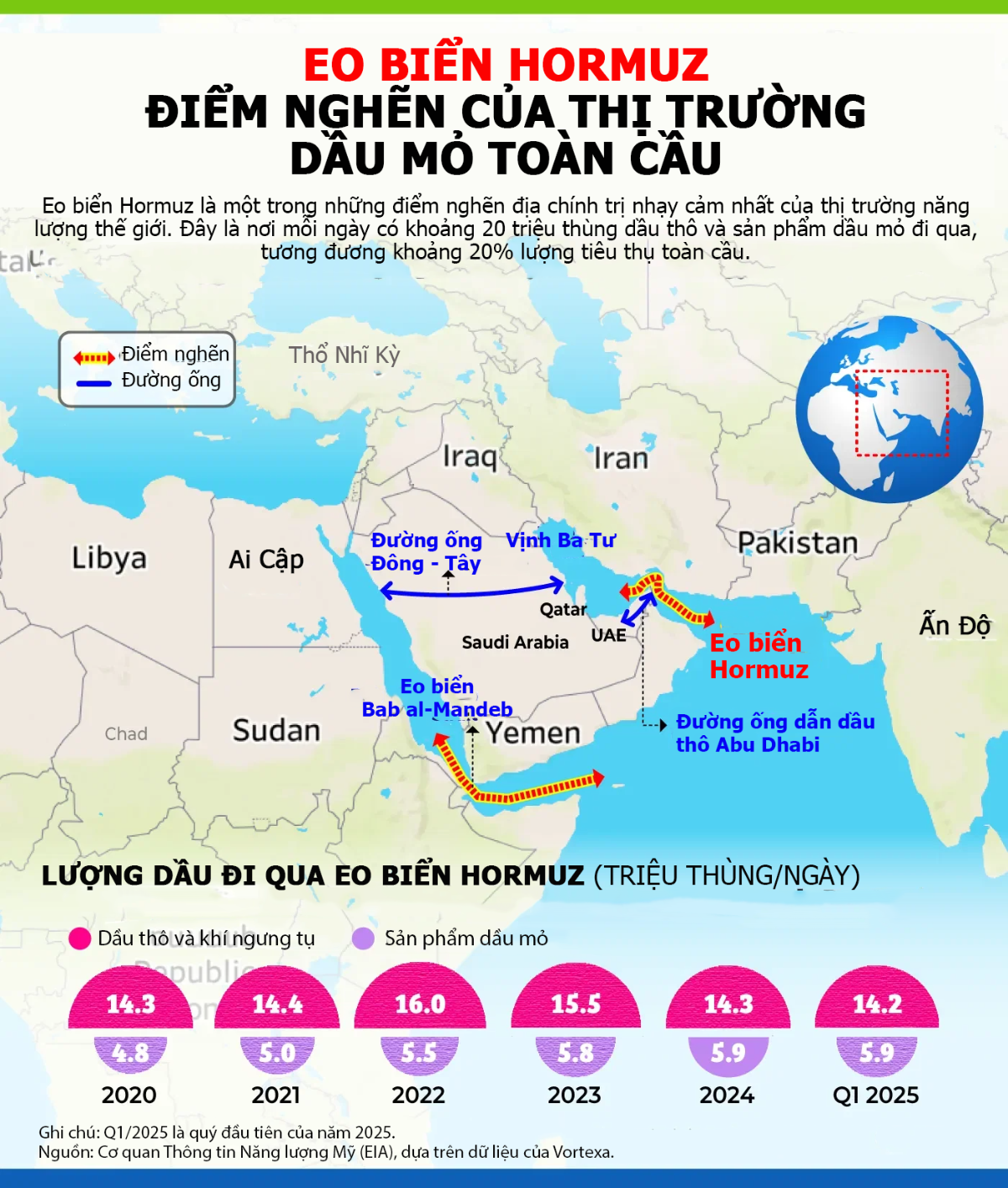
Located between the Persian Gulf and the Indian Ocean, the Strait of Hormuz serves as the gateway through which oil from major Gulf exporters reaches global markets. This makes the shipping lane a critical link in global energy security and one of the most sensitive geopolitical chokepoints in the oil market.
Data from 2020 through the first quarter of 2025 show that the volume of oil passing through Hormuz has consistently remained high.
Crude oil and condensate flows reached 14.3 million barrels per day in 2020, rising to 14.4 million barrels per day in 2021 and peaking at 16 million barrels per day in 2022. The volume then eased slightly to 15.5 million barrels per day in 2023, 14.3 million barrels per day in 2024, and 14.2 million barrels per day in the first quarter of 2025.
Meanwhile, shipments of refined petroleum products through the Strait of Hormuz have grown more steadily than crude flows. From 4.8 million barrels per day in 2020, the volume increased to 5 million barrels per day in 2021, 5.5 million barrels per day in 2022, 5.8 million barrels per day in 2023, and about 5.9 million barrels per day in both 2024 and the first quarter of 2025.
Combined flows of crude oil, condensate and petroleum products passing through Hormuz in recent years have hovered around 20 million barrels per day, equivalent to roughly 20 percent of global consumption.
These figures underscore the central role of this shipping route in the global energy market, a position that has remained largely unchanged over the years. The trend also suggests that while crude oil demand and production fluctuate with market cycles, downstream trade activity has remained relatively stable.
The significance of Hormuz lies in the fact that even a brief disruption at the strait could trigger sharp movements in oil prices almost immediately. For Asia and Europe, two regions heavily dependent on supplies from the Gulf, any risk to tanker traffic through this passage could cause supply shocks, driving up energy costs and intensifying inflationary pressures.
Following coordinated airstrikes by the United States and Israel targeting Iran last Saturday (February 28), a senior official of Iran’s Islamic Revolutionary Guard Corps said on Monday (March 2) that Tehran would close the Strait of Hormuz and warned it would attack any vessel attempting to pass through the waterway. The development quickly disrupted shipping activity in the region, with many oil tankers forced to anchor or suspend their journeys.
Analysts say that in the short term, existing alternative pipelines and routes in Saudi Arabia and the United Arab Emirates can only handle part of the volume that typically passes through Hormuz. This means substitute routes would struggle to fully replace the flow of oil normally transported through the strait if disruptions were prolonged.
Source: vneconomy.vn

