


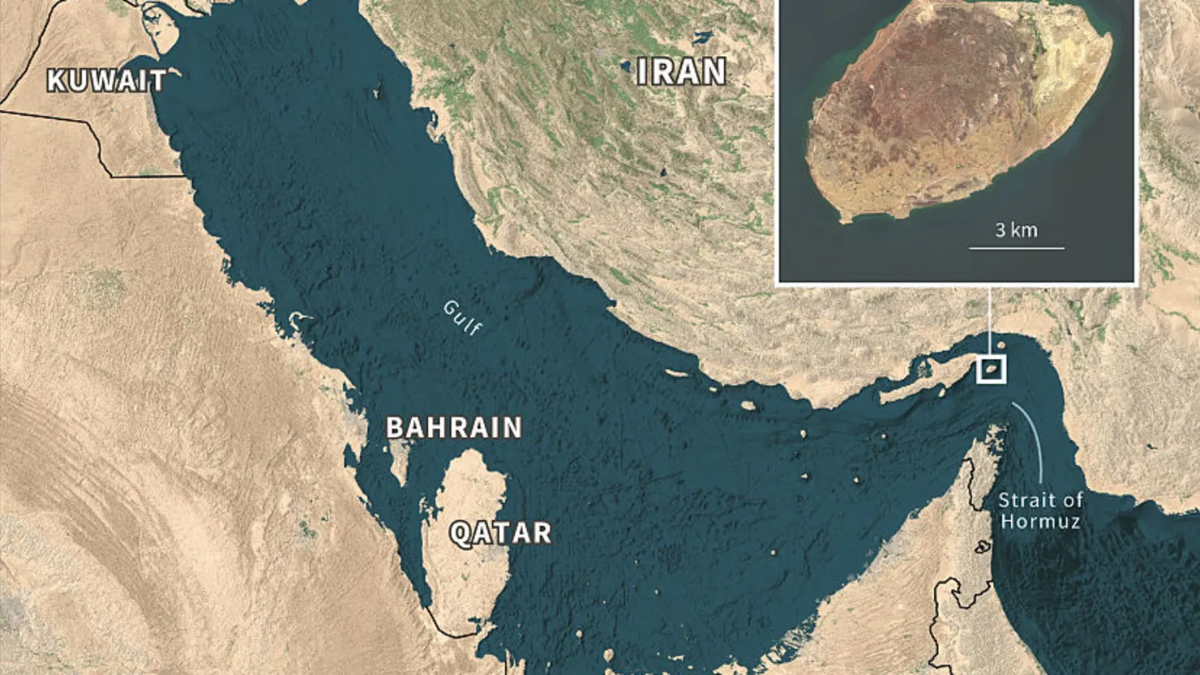
Since the outbreak of the U.S.–Iran conflict on February 28, traffic through the Strait of Hormuz has dropped by as much as 90%, as Iran has threatened and targeted vessels attempting to pass through the vital waterway.
The disruption has delivered a major shock to global energy supplies, sending oil prices soaring and raising concerns over energy security.
A SHIPPING CORRIDOR ESTABLISHED
According to CNBC, Iran has set up an informal safe shipping corridor north of Larak Island, near the coast of the port city of Bandar Abbas. There, Iran’s Islamic Revolutionary Guard Corps (IRGC) and port authorities inspect each vessel before allowing passage. Maritime research firm Lloyd’s List Intelligence said the IRGC has effectively imposed an informal “toll booth” regime in the Strait of Hormuz.
Over the past three weeks, nearly all vessels transiting the strait have been routed through the narrow channel north of Larak Island, close to Iran’s coastline, indicating a controlled and licensed corridor with access granted only to selected ships. All 57 voyages recorded through the strait since March 13 have taken the Larak detour, with virtually none following the usual route, Lloyd’s said.
Satellite observations also show ships queuing north of Larak Island awaiting clearance. Several vessels have reportedly been denied passage in recent days, according to maritime intelligence firm Windward.
This week, Iran’s parliament passed a bill to formalize transit fees for vessels passing through the Strait of Hormuz—effectively institutionalizing Tehran’s financial control over this critical maritime route. According to CNBC, the bill—under international law, which would require consent from other littoral states—imposes fees on shipments of energy, food, and other goods.
At least two vessels have already paid fees to Iranian authorities, with payments reportedly made in Chinese yuan, Lloyd’s said. One transit was arranged through a Chinese maritime services firm, which also handled the payment, though details of the amount and method remain unclear.
Iran is taking precautionary measures to ensure that only selected vessels are allowed through, prioritizing countries with friendly ties or ships linked to Iranian trade, said Bridget Diakun, a senior risk and compliance analyst at Lloyd’s List Intelligence.
The conflict has now stretched nearly six weeks, with Washington and Tehran offering conflicting accounts on whether serious negotiations are underway. In a national address on April 1 (U.S. time), President Donald Trump said the U.S. campaign could end within “two or three weeks,” while warning of potentially intensified strikes in the same timeframe. Iran’s Foreign Minister Abbas Araghchi confirmed that messages have been exchanged with the U.S., but said they do not constitute “negotiations.”
According to Lloyd’s List Intelligence, under Iran’s procedures, ship operators must first approach intermediaries linked to the IRGC and submit detailed documentation, including the vessel’s IMO number, crew names, and final destination. The IRGC screens the information and, if approved, issues a clearance code along with routing instructions.
Once a vessel enters Iranian waters, IRGC commanders contact it via maritime radio channels to request the clearance code. If approved, an Iranian vessel escorts it through territorial waters around Larak Island. Ships that fail the screening process are denied passage.
FRIENDLY NATIONS’ VESSELS PRIORITIZED
Determining vessel ownership is complicated by multiple layers of registration, including flag state, registered ownership, crew nationality, and final destination. However, among the recorded transits, most vessels were linked to Iran, Greece, and China, with a smaller number associated with Pakistan and India.
Several governments—including India, Pakistan, Iraq, Malaysia, and China—are believed to have engaged in direct talks with Tehran to ensure their vessels can pass IRGC screening. Two ultra-large container ships linked to China’s state-owned Cosco Shipping group transited the Larak corridor earlier this week after initially being denied.
India has reportedly secured safe passage for its oil tankers through the strait without paying fees or seeking prior approval, according to local media citing a government official. New Delhi has praised direct negotiations with Iran as the most effective way to restore shipping through Hormuz.
The Indian-flagged LPG carrier Pine Gas transited the strait last month after receiving routing instructions from IRGC commanders to divert to the Larak channel. It was escorted by Indian naval vessels and did not pay any fees, Reuters reported.
Southeast Asian countries heavily affected by the fuel supply shock, such as Malaysia and Thailand, are also believed to have received assurances from Iran for safe passage following diplomatic engagement with Tehran.
However, under international law, Iran has no legal authority to impose general transit fees on vessels passing through the Strait of Hormuz, said Shahla Ali, a law professor at the University of Hong Kong. “Any unilateral measure by Iran’s parliament to impose broad transit fees in the Strait of Hormuz would be inconsistent with international maritime law and likely face strong diplomatic and legal challenges,” Ali said.
Experts also note that comparisons between the Strait of Hormuz and the Suez and Panama canals are unfounded. While both canals charge transit fees, they are man-made waterways built, maintained, and operated by sovereign states. The Panama Canal Authority applies standardized, non-discriminatory fees based on vessel size and type, according to the European Parliament Research Service.
Source: vneconomy.vn

