


The plan not only targets export turnover but also focuses on enhancing competitiveness and contributing to the capital’s overall GRDP growth target of 11% or higher.
STRIVING FOR STRONG GROWTH IN KEY MARKETS
Under Plan No. 22/KH-UBND signed by Vice Chairman of the Hanoi People’s Committee Nguyen Manh Quyen on January 15, 2026, Hanoi has set export growth targets by market region ranging from 7% to 15%.
The city aims to maintain stability in traditional markets such as the United States, the EU, Japan, South Korea, China and ASEAN. At the same time, Hanoi will maximize advantages from new-generation free trade agreements (FTAs) such as EVFTA, CPTPP, RCEP and VIFTA, while intensifying efforts to tap into emerging markets in the Middle East, South Asia, Africa and Latin America.
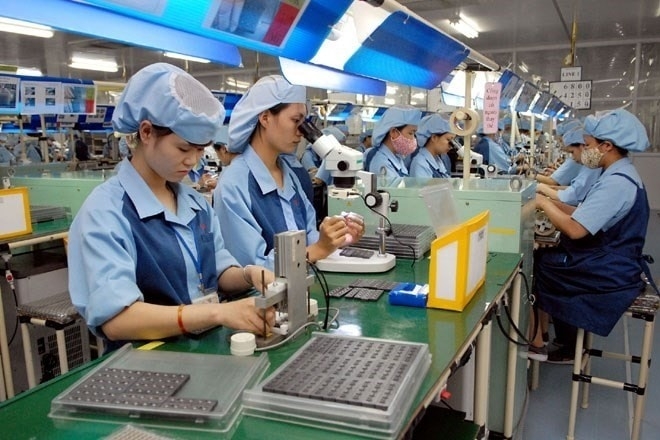
Regarding sectoral structure, the city focuses on promoting high value-added and high-tech product groups. Specific growth targets for key export sectors include: computers, electronic products and components, up 11% to 14%; handicrafts and ceramics, expected to record the highest growth of 12% to 18%; textiles and footwear, up 10% to 13%; agricultural products and processed foods, targeted at 10% to 15%; wood and wood products, up 10% to 14%.
For business groups, the city places particular emphasis on the role of FDI enterprises, projected to grow by 10%–12%, and large domestic enterprises, targeted at 12%–13%. Hanoi also aims to expand the number of enterprises with annual export turnover exceeding USD 100 million. Small and medium-sized enterprises are expected to increase the number of firms participating directly or indirectly in exports by 10% to 15%.
Notably, Hanoi targets that at least 30% of enterprises benefiting from the city’s support policies will secure new export orders. Products from craft villages and OCOP programs are also expected to increase by at least 20% in the number of items participating in export activities.
IMPROVING LOGISTICS INFRASTRUCTURE, PROMOTING CROSS-BORDER DIGITAL TRANSFORMATION
To realize these goals, Hanoi is implementing a synchronized set of solutions, with a focus on infrastructure development and the application of science and technology. The city aims to increase by at least 10% the number of enterprises using domestic logistics services, reduce input and output logistics costs in the export chain to reasonable levels, and expand the number of export products with electronic traceability.
Hanoi will coordinate investments to standardize the logistics system, including warehouses, container yards, ICD ports and multimodal logistics centers, ensuring seamless connectivity among seaports, road networks, expressways and airports. In particular, the trend toward green logistics and carbon emission reduction is prioritized to meet stringent environmental standards in international markets.
In the digital era, Hanoi is stepping up support for exporters through cross-border e-commerce, aiming to increase by 15% to 20% the number of participating enterprises. Support measures include building digital storefronts and implementing international marketing strategies; enhancing the application of information technology in production management, electronic traceability and export-import data management; and further simplifying procedures in taxation and customs while expanding online public services to reduce transaction costs for businesses.
At the same time, the city will intensify trade promotion activities, support enterprises in brand building, and promote Hanoi products in international markets. Coordination among businesses, industry associations and training institutions will be strengthened to develop high-quality human resources that meet the stringent requirements of global supply chains.
Hanoi also seeks to expand the number of supporting industry enterprises participating in export supply chains of FDI and large-scale enterprises, and to increase the number of Hanoi products with established brands and trademarks in export markets.
Administrative reforms in trade, export, taxation and customs will continue, alongside expanded online public services to lower transaction costs. Cooperation among enterprises, training institutions and industry associations will be enhanced in developing high-quality human resources.
The city will further promote the connection, exploitation and application of export-import data in state management, support market forecasting, and provide transparent and timely information.
Source: vneconomy.vn

