


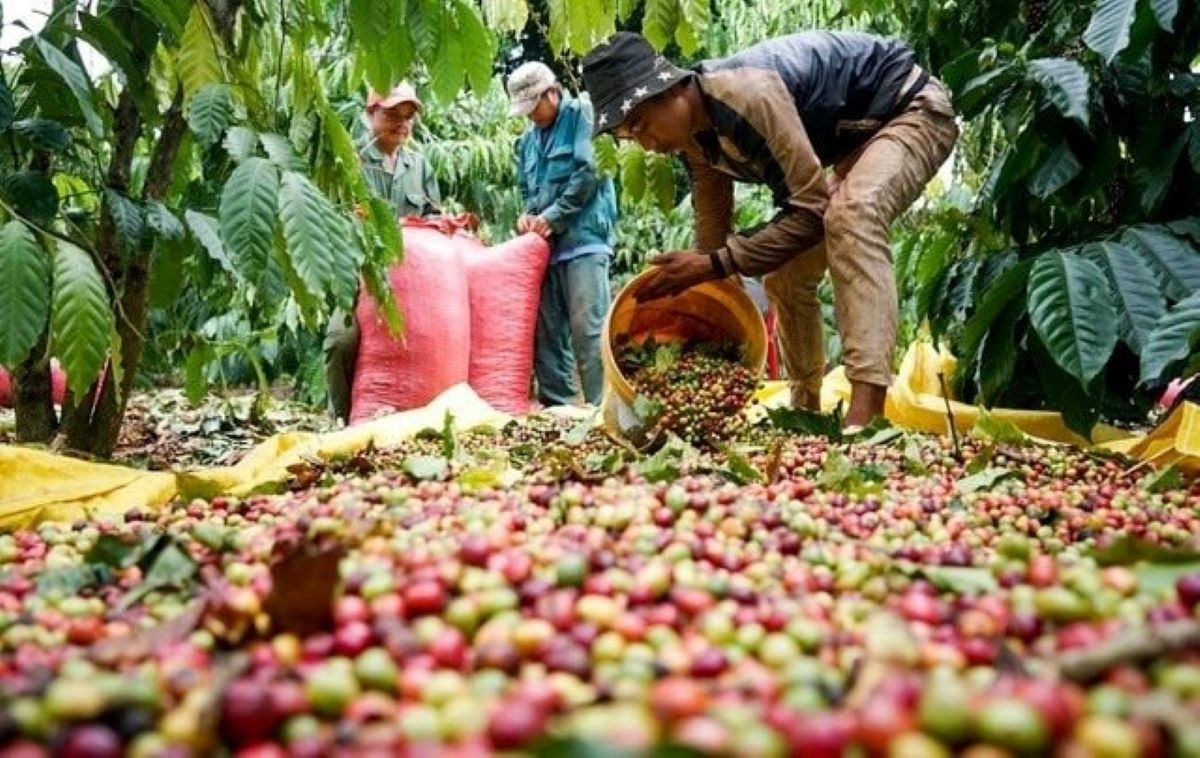
The decline in coffee export value is mainly attributed to a sharp drop in average export prices. In the first quarter of 2026, the export price was estimated at USD 4,696.8 per ton, down 16.9% compared to the same period last year, leading to a decrease in export value despite higher volumes.
COFFEE PRICES FALL, TRADING REMAINS SUBDUED
In terms of markets, Germany, Italy, and Spain continued to be Vietnam’s three largest coffee consumers, with market shares of 16.4%, 8.6%, and 7.6%, respectively. Compared to the same period in 2025, exports to Germany rose slightly by 3.2%, Spain increased by 14.1%, while Italy declined by 11.5%.
Notably, among the top 15 largest markets, China recorded the strongest growth, doubling year-on-year, while the Philippines saw a sharp decline of 23.9%. These developments indicate that global coffee demand remains stable but is shifting across markets, reflecting increasing competitive pressures and price volatility.
According to the Ministry of Agriculture and Environment, in March 2026, coffee prices in the Central Highlands fell by VND 2,500–2,800 per kilogram compared to the previous month. Specifically, in Dak Nong, purchasing prices reached VND 93,800/kg, down VND 2,800/kg; Dak Lak and Gia Lai were both at VND 93,700/kg, down VND 2,700/kg; Lam Dong was around VND 93,000/kg, down about VND 2,500/kg.
The decline was mainly due to expectations of a record coffee harvest in Brazil, the world’s largest coffee producer. Although disruptions in transportation through the Strait of Hormuz partially increased logistics costs, this factor was insufficient to offset global oversupply pressures.
Domestic markets also recorded relatively sluggish trading activity as many farmers held back sales, expecting prices to recover. Meanwhile, exporters needing to fulfill contracts shifted to sourcing coffee from Brazil and Indonesia to ensure supply.
On the international market, coffee prices in March 2026 showed diverging trends between Robusta and Arabica. For Robusta, improved global supply exerted downward pressure. During the month, May futures prices on the London exchange fluctuated between USD 3,455 and USD 3,772 per ton.
In contrast, Arabica prices were supported by concerns over a shortage of high-quality supply. May futures on the New York exchange reached a high of 317.85 US cents per pound and a low of 283.15 US cents per pound during the same period.
Entering early April 2026, both coffee types declined. By the close of the trading session in the early hours of April 3 (Vietnam time), Robusta prices fell to USD 3,448 per ton, while Arabica also declined, reflecting a general weakening trend in the market.
Experts noted that a stronger US dollar, along with abundant supply prospects from Brazil and Uganda, are key factors driving coffee prices downward. Additionally, news of expanding coffee cultivation areas in many countries has further impacted market sentiment, pushing prices lower.
Although coffee prices remain relatively high compared to previous years, the recent downward trend is raising concerns among farmers. Production costs, particularly fertilizers and labor, continue to stay high, narrowing farmers’ profit margins.
IMPROVING QUALITY TO INCREASE VALUE
Amid market fluctuations, Vietnam’s coffee industry faces the need for strong transformation, not only in output but also in quality and value addition.
At the recent workshop “Expert Consultation on Quality and Market Transformation for Robusta,” organized by the Buon Ma Thuot Coffee Association, experts and businesses emphasized the importance of building a quality standards system for Vietnamese Robusta coffee.
According to Mr. Le Duc Huy, a representative of the association, Vietnam has established its position as the world’s leading Robusta producer. However, advantages in output do not necessarily translate into leadership in quality standards or value-setting in the international market.
Therefore, the “Robusta XXI” initiative has been launched to develop a science-based quality assessment framework, aiming to establish voluntary standards for Vietnamese Robusta coffee. This is seen as an important step toward enhancing product value and competitiveness.
Participants at the workshop agreed that to move into a new development phase, the coffee industry cannot focus solely on increasing output but must place greater emphasis on measurement, standardization, and building a “quality language” for its products.
In addition, building trust with international buyers plays a crucial role. Businesses expect that, if effectively implemented, the Robusta XXI initiative will contribute to developing a quality ecosystem, enabling Vietnamese Robusta coffee not only to remain a major export product but also to have a voice in shaping global standards.
In the short term, the coffee market is expected to remain under pressure from rising supply and global economic fluctuations. However, in the long term, Vietnam’s coffee industry still holds significant opportunities if it can leverage its production strengths while transitioning toward sustainable development and higher quality.
Deeper participation in the global value chain, along with initiatives such as Robusta XXI, is expected to help Vietnamese coffee not only maintain its position in terms of output but also enhance its value and brand in the international market.
Source: vneconomy.vn

